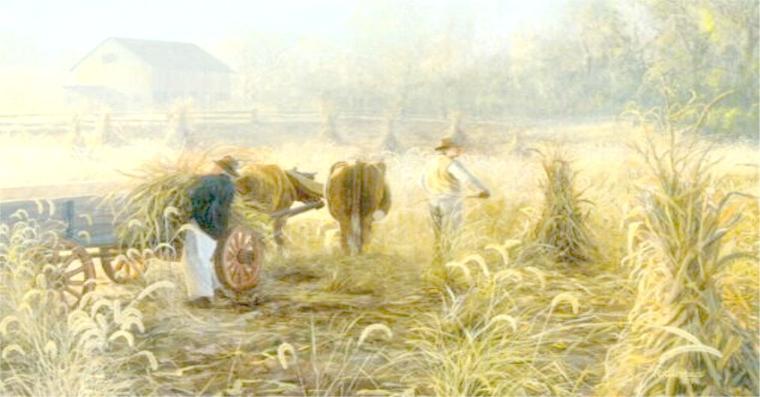
And now for the best part.......THE FOOD!
Lughnassadh Recipes
SUMMER VEGGIE GOULASH
As fresh veggies come into season, this recipe always comes to mind. It is a variation of the poor
food of my childhood, and with the addition of fresh seasonal food it feels like summer to me. You
can also add other canned food from the cupboard. Get creative with it!
Recipes from The Rising Wind, submitted by Tami Cheshire
INGREDIENTS:
1 lb of hamburger
3-5 lbs of potatoes, diced (my mom always liked potatoes)
3-4 ears of corn for fresh kernels
2-3 green bell peppers, diced
1 medium onion, diced
2 lbs of green beans, diced
1-2 cans of tomato sauce
1/2 c. catchup (or more - mom liked catchup too)
Garlic Salt
Water
Fresh or dried herbs: I like rosemary, thyme, dill and/or basil
INSTRUCTIONS:
How to cut fresh kernels:
Stand ear of corn on it's end. While holding the ear at a diagonal, use a sharp, non-serrated knife to
cut down the edge of the corn, freeing the corn from the ear. The kernels will fall to the bottom (so
do this on a cutting board). Turn the corn a bit and repeat. Free all the kernels from the corn before
starting this recipe.
In a large pot, brown the hamburger. As it browns, sprinkle with garlic salt and pepper. You can
add other spices at this stage. Once the meat is cooked, drain it and remove the hamburger. In the
same pot, sauté the onion in a bit of oil. After the onion has cooked for a bit, add the green peppers
and sauté both until they are about 3/4 cooked. Add the hamburger back as well as the potatoes,
corn, and green beans. Give this all a nice good stir and add the cans of tomato sauce and ketchup.
Add water until the veggies and meat are just submerged. Add the rest of the herbs and boil on
medium-high, stirring occasionally. Once the potatoes are soft, it is done. This goulash is well
served with....
CORN BREAD EAR STICKS
Purchase an iron mold shaped like little ears of corn in flea markets or kitchen supply shops, or look
in grandma's kitchen wherever she keeps her bakeware - there just might be one there already!
Grease lightly and preheat in a 425 degree oven. You will need:
INGREDIENTS:
3/4 cup Flour
3/4 cup Yellow Corn Meal
1/4 cup Sugar
3/4 teaspoon Salt
2 teaspoons Baking Powder
2 Eggs
1 cup Milk (or Buttermilk if you prefer)
1/4 cup Shortening
INSTRUCTIONS:
Sift dry ingredients together. Add milk, eggs, shortening, and beat until smooth. Pour into preheated
and greased molds and bake 20-25 minutes or until golden brown.
BAKED ACORN SQUASH
INGREDIENTS:
1 acorn squash, halved and seeded
1 T butter
2 T brown sugar
DIRECTIONS:
Preheat oven to 175F. Place squash cut-side down on a baking sheet. Bake for about half to three
quarters of an hour, until the squash begins to soften. Remove from the oven, and turn cut-side up.
Rub butter and brown sugar into the middle of both squash halves.
Place one half on top of the other (cut-sides together) and put squash back in the oven for another
30 minutes.
WILD HERB SALAD WITH VINAIGRETTE - Laurie Cabot
INGREDIENTS:
4 nasturtium flowers and 16 leaves
12 red clover blossoms
4 sprigs basil
4 sprigs rosemary
4 kale leaves
4 purple mustard leaves
12 violet leaves
8 dandelion leaves
DIRECTIONS:
Toss all ingredients in a large salad bowl charged with the energy of the sun.
For the dressing:
4 Tbsp. olive oil
2 Tbsp. balsamic vinegar
1/2 tsp. minced garlic
Add to the salad just before serving and enjoy!
ROASTED CORN ON THE COB - Laurie Cabot
INGREDIENTS:
fresh ears of corn
water
butter
salt and pepper
DIRECTIONS:
Pull down husks on corn without pulling off. Remove silk threads. Rinse corn with water. Rub
with butter, salt, and pepper. Replace husks, twisting to secure. Place in oven at 400º F for 25
minutes or on grill for the same amount of time.
BERRIES AND CREAM - Laurie Cabot
INGREDIENTS:
1/2 lb. fresh strawberries
1/2 lb. fresh blueberries
1/2 lb. fresh raspberries (if available)
1/2 lb. fresh blackberries
1 pint whipping cream (heavy cream)
1 tsp. sugar
DIRECTIONS:
Toss berries in a large bowl. Whip cream in a small bowl with beaters that have been chilled in the
refrigerator for 2 hours. Whip until the cream is thick and light and forms stiff peaks.
Lughnassadh Recipes
SUMMER VEGGIE GOULASH
As fresh veggies come into season, this recipe always comes to mind. It is a variation of the poor
food of my childhood, and with the addition of fresh seasonal food it feels like summer to me. You
can also add other canned food from the cupboard. Get creative with it!
Recipes from The Rising Wind, submitted by Tami Cheshire
INGREDIENTS:
1 lb of hamburger
3-5 lbs of potatoes, diced (my mom always liked potatoes)
3-4 ears of corn for fresh kernels
2-3 green bell peppers, diced
1 medium onion, diced
2 lbs of green beans, diced
1-2 cans of tomato sauce
1/2 c. catchup (or more - mom liked catchup too)
Garlic Salt
Water
Fresh or dried herbs: I like rosemary, thyme, dill and/or basil
INSTRUCTIONS:
How to cut fresh kernels:
Stand ear of corn on it's end. While holding the ear at a diagonal, use a sharp, non-serrated knife to
cut down the edge of the corn, freeing the corn from the ear. The kernels will fall to the bottom (so
do this on a cutting board). Turn the corn a bit and repeat. Free all the kernels from the corn before
starting this recipe.
In a large pot, brown the hamburger. As it browns, sprinkle with garlic salt and pepper. You can
add other spices at this stage. Once the meat is cooked, drain it and remove the hamburger. In the
same pot, sauté the onion in a bit of oil. After the onion has cooked for a bit, add the green peppers
and sauté both until they are about 3/4 cooked. Add the hamburger back as well as the potatoes,
corn, and green beans. Give this all a nice good stir and add the cans of tomato sauce and ketchup.
Add water until the veggies and meat are just submerged. Add the rest of the herbs and boil on
medium-high, stirring occasionally. Once the potatoes are soft, it is done. This goulash is well
served with....
CORN BREAD EAR STICKS
Purchase an iron mold shaped like little ears of corn in flea markets or kitchen supply shops, or look
in grandma's kitchen wherever she keeps her bakeware - there just might be one there already!
Grease lightly and preheat in a 425 degree oven. You will need:
INGREDIENTS:
3/4 cup Flour
3/4 cup Yellow Corn Meal
1/4 cup Sugar
3/4 teaspoon Salt
2 teaspoons Baking Powder
2 Eggs
1 cup Milk (or Buttermilk if you prefer)
1/4 cup Shortening
INSTRUCTIONS:
Sift dry ingredients together. Add milk, eggs, shortening, and beat until smooth. Pour into preheated
and greased molds and bake 20-25 minutes or until golden brown.
BAKED ACORN SQUASH
INGREDIENTS:
1 acorn squash, halved and seeded
1 T butter
2 T brown sugar
DIRECTIONS:
Preheat oven to 175F. Place squash cut-side down on a baking sheet. Bake for about half to three
quarters of an hour, until the squash begins to soften. Remove from the oven, and turn cut-side up.
Rub butter and brown sugar into the middle of both squash halves.
Place one half on top of the other (cut-sides together) and put squash back in the oven for another
30 minutes.
WILD HERB SALAD WITH VINAIGRETTE - Laurie Cabot
INGREDIENTS:
4 nasturtium flowers and 16 leaves
12 red clover blossoms
4 sprigs basil
4 sprigs rosemary
4 kale leaves
4 purple mustard leaves
12 violet leaves
8 dandelion leaves
DIRECTIONS:
Toss all ingredients in a large salad bowl charged with the energy of the sun.
For the dressing:
4 Tbsp. olive oil
2 Tbsp. balsamic vinegar
1/2 tsp. minced garlic
Add to the salad just before serving and enjoy!
ROASTED CORN ON THE COB - Laurie Cabot
INGREDIENTS:
fresh ears of corn
water
butter
salt and pepper
DIRECTIONS:
Pull down husks on corn without pulling off. Remove silk threads. Rinse corn with water. Rub
with butter, salt, and pepper. Replace husks, twisting to secure. Place in oven at 400º F for 25
minutes or on grill for the same amount of time.
BERRIES AND CREAM - Laurie Cabot
INGREDIENTS:
1/2 lb. fresh strawberries
1/2 lb. fresh blueberries
1/2 lb. fresh raspberries (if available)
1/2 lb. fresh blackberries
1 pint whipping cream (heavy cream)
1 tsp. sugar
DIRECTIONS:
Toss berries in a large bowl. Whip cream in a small bowl with beaters that have been chilled in the
refrigerator for 2 hours. Whip until the cream is thick and light and forms stiff peaks.
Lammas Activities
Wheat Weaving
by: Diane Balsamo
A powerful symbol of the Lord of the Grain and the Corn Mother can be found in Wheat Weaving.
These wonderful, natural works of art were often woven by farmers as a prayer for plenty and
blessings, and hung upon doorways, barns and so forth. They have always fascinated me as I try to
visualize the process. Regretfully I have never quite been able to master the technique for the
elaborate ones. A simple, meaningful symbol can, however, be made by anyone who can braid.
What you will need (per weaving) :
3 stalks of wheat or rye or spelt ( if you do not have access to a farm, check out one of the big craft
stores in the floral department)
A piece of ribbon or yarn (maybe green for prosperity)
First, you will need to soak your wheat stalks in water to make them supple. I have found the best
soaking place to be the bath tub. Soak the stalks for about 20 minutes, and then begin to work.
Starting at the grain head, simply braid until you have reached the end. Then tie this off with the
yarn, and bend the finished end to meet the grain heads (forming a loop). Tie these together, and
finish off with a bow tied up from the ribbon or yarn. Simple- and looks like you are very crafty!
I hang these in our doorways, in windows, and all over. They remain up until a little after Mabon,
and are hidden away at Samhain. I place them on our Yule tree as a prayer for plenty in the coming
year, and then at Imbolc they are hung out on our trees - so that the Mother may return (and feed
her very hungry little ones at this time of year).
If you have children wanting to do this with you, you might want to have LOTS of wheat on hand.
(Alas, even my grandchildren are grown so this Crone does all the work herself. Of course with the
help of my furbabies who like to chew them up and spread them around the room.) Kids really get
into making things to be displayed. And while you are braiding away, what better time to talk about
the cycles of seed and grain and fruit- as well as the eternal return.
Lughnasadh Ritual
Cast the circle and call the Quarters... Pick up your wand with your right hand, face the North with
your arms stretched out above your head and say:
"The wheel of the Year turns on and on,
Blessed be the harvest,
Blessed Be the fruitful Corn Mother
Blessed Be the God of the Harvest.
I partake of the First Harvest,
fruit of the womb of the Goddess.
Blessed Be Mother Earth..."
Place your Wand back in its place on the altar. Spread your hands out over the harvested foods on
the altar and say these words:
" Blessed Be the fruitful Corn Mother
Blessed Be the God of the Harvest
As I continue my quest,
may these seeds be buried in Mother Earth
and ensure that the birth of Spring will be glorious
I ask that you except my offer of bread and juice
in hopes that you, Mother Earth
will look after all the Fairy's
and the animals in the forest
I make my humble offer to you Mother Earth..."
Now name all the things that you are currently grateful for. With each item that you name, break off
a piece of the Cornbread and eat it. Sip from the chalice filed with Apple Cider as well. When
finished with the list of blessings, take the small handful of the Grain from your alter and hold it in
your open hand at face level saying:
" My Guardian of the East please indulge me:
Hear me now for I am in need of a request
Help Mother Earth carry out the duty
of planting and nurturing each and every seed.
Protect them and nourish them on their journey
until next Spring
when they will blossom and bring life anew.
I give thanks to the Great Mother,
Goddess of the fertile land,
of all lakes and air.
Of the blessings I partake and share
Blessed Be this Harvest night!"
Face the alter and assume the Goddess position saying:
"Blessed Be our Mother,
whose womb contains and bears all life
Blessed Be our Father
whose seed plants all life
Blessed Be the Two that are One
From them life flows and flows back again."
Now is the time for meditation and spell workings. If no spell workings are to be done, proceed with
the Cakes and Ale ceremony, followed by releasing the Circle.
It is appropriate to plant the seeds from the fruit consumed in ritual. If they sprout, grow the plant
with love as a symbol of your connection with the Goddess and God. Wheat weaving (making of
corn dollies) is a good activity for Lughnasadh.
Wheat Weaving
by: Diane Balsamo
A powerful symbol of the Lord of the Grain and the Corn Mother can be found in Wheat Weaving.
These wonderful, natural works of art were often woven by farmers as a prayer for plenty and
blessings, and hung upon doorways, barns and so forth. They have always fascinated me as I try to
visualize the process. Regretfully I have never quite been able to master the technique for the
elaborate ones. A simple, meaningful symbol can, however, be made by anyone who can braid.
What you will need (per weaving) :
3 stalks of wheat or rye or spelt ( if you do not have access to a farm, check out one of the big craft
stores in the floral department)
A piece of ribbon or yarn (maybe green for prosperity)
First, you will need to soak your wheat stalks in water to make them supple. I have found the best
soaking place to be the bath tub. Soak the stalks for about 20 minutes, and then begin to work.
Starting at the grain head, simply braid until you have reached the end. Then tie this off with the
yarn, and bend the finished end to meet the grain heads (forming a loop). Tie these together, and
finish off with a bow tied up from the ribbon or yarn. Simple- and looks like you are very crafty!
I hang these in our doorways, in windows, and all over. They remain up until a little after Mabon,
and are hidden away at Samhain. I place them on our Yule tree as a prayer for plenty in the coming
year, and then at Imbolc they are hung out on our trees - so that the Mother may return (and feed
her very hungry little ones at this time of year).
If you have children wanting to do this with you, you might want to have LOTS of wheat on hand.
(Alas, even my grandchildren are grown so this Crone does all the work herself. Of course with the
help of my furbabies who like to chew them up and spread them around the room.) Kids really get
into making things to be displayed. And while you are braiding away, what better time to talk about
the cycles of seed and grain and fruit- as well as the eternal return.
Lughnasadh Ritual
Cast the circle and call the Quarters... Pick up your wand with your right hand, face the North with
your arms stretched out above your head and say:
"The wheel of the Year turns on and on,
Blessed be the harvest,
Blessed Be the fruitful Corn Mother
Blessed Be the God of the Harvest.
I partake of the First Harvest,
fruit of the womb of the Goddess.
Blessed Be Mother Earth..."
Place your Wand back in its place on the altar. Spread your hands out over the harvested foods on
the altar and say these words:
" Blessed Be the fruitful Corn Mother
Blessed Be the God of the Harvest
As I continue my quest,
may these seeds be buried in Mother Earth
and ensure that the birth of Spring will be glorious
I ask that you except my offer of bread and juice
in hopes that you, Mother Earth
will look after all the Fairy's
and the animals in the forest
I make my humble offer to you Mother Earth..."
Now name all the things that you are currently grateful for. With each item that you name, break off
a piece of the Cornbread and eat it. Sip from the chalice filed with Apple Cider as well. When
finished with the list of blessings, take the small handful of the Grain from your alter and hold it in
your open hand at face level saying:
" My Guardian of the East please indulge me:
Hear me now for I am in need of a request
Help Mother Earth carry out the duty
of planting and nurturing each and every seed.
Protect them and nourish them on their journey
until next Spring
when they will blossom and bring life anew.
I give thanks to the Great Mother,
Goddess of the fertile land,
of all lakes and air.
Of the blessings I partake and share
Blessed Be this Harvest night!"
Face the alter and assume the Goddess position saying:
"Blessed Be our Mother,
whose womb contains and bears all life
Blessed Be our Father
whose seed plants all life
Blessed Be the Two that are One
From them life flows and flows back again."
Now is the time for meditation and spell workings. If no spell workings are to be done, proceed with
the Cakes and Ale ceremony, followed by releasing the Circle.
It is appropriate to plant the seeds from the fruit consumed in ritual. If they sprout, grow the plant
with love as a symbol of your connection with the Goddess and God. Wheat weaving (making of
corn dollies) is a good activity for Lughnasadh.
Tools, Symbols, and Decorations
Corn
Cornucopias
Red, yellow flowers
First fruits/vegetables of Garden labor
Corn dollies
Baskets of bread
Spear
Cauldron
Sickle
Scythe
Threshing tools
Sacred loaf of bread
Harvested herbs
Bonfires
God figures made of bread or cookie dough
Phallic symbols
Herbs and Plants of Lughnassadh
Lughnassadh is the first of the three harvest Sabbats. It marks the beginning of the harvest season
and the decline of Summer into Winter. Many grains, seeds, herbs and fruits can be harvested and
dried at this time for later use through the remaining year. Corn is one of the vital crops harvested
now, and in some areas the sacrifice of the corn king is performed.
Herbs and plants associated with this sabbat are:
acacial flowers
aloe
apple leaf
barley
basil
bee pollen
bilberry leaf
black berries
blackthorn
blueberry leaf
boneset
clover blossom
comfrey
corn/cornstalks
crab apples
elder
fenugreek
first fruits and vegetables of the garden
frankincense
garlic
goldenrod
grapes
grape vine
hazelnut
heather
heliotrope
holly
hollyhock
hops
irish moss
ivy
marigold
meadowsweet
milkweed
mint
mistletoe
mugwort
mushroom
myrtle
nasturtium
oak
oat
onion
pears
peony
poppy
Queen Anne's lace
raspberry leaf
rice
rose
rye
sloe
strawberry leaf
sunflower
vervain
yarrow
Colors associated with Lammas are:
Stones associated with Lammas are:
yellow diamond, aventurine, citrine, peridot, and sardonyx.
Animals and mythical beasts associated with Lammas are:
roosters, calves, pigs, phoenix, griffins, basilisk, centaurs.
Appropriate Lammas Goddesses are:
all Grain Deities, Livestock Goddesses, Mother Goddesses. Some Lammas Goddesses are: Alphito
(Irish) Morgay (English), Selu (Cherokee), Demeter (Greek), Marcia (Italian), Mama Alpa (Incan)
Appropriate Lammas Gods are:
all Father Gods, Livestock Gods, Grain Deities. Some Lammas Gods are: Liber (Roman), Llew
(Welsh), Nepher (Egyptian), Xochipilli (Aztec) , Lugh (Irish), Odin (Norse), Lono (Polynesian),
Dagon (Phoenician).
Altar decorations can consist of:
Sunflowers, woven sheaves of wheat, corn,baked bread, Moonstones, Agates, Corn Husk Dollies,
Fruits of the Season.
Traditional activities during Lammas consist of:
making Corn husk dolls, climbing mountains, attending craft festivals, baking bread.
Taboos on Lammas are:
not sharing food.
Spellwork can be for:
fertility.
Corn
Cornucopias
Red, yellow flowers
First fruits/vegetables of Garden labor
Corn dollies
Baskets of bread
Spear
Cauldron
Sickle
Scythe
Threshing tools
Sacred loaf of bread
Harvested herbs
Bonfires
God figures made of bread or cookie dough
Phallic symbols
Herbs and Plants of Lughnassadh
Lughnassadh is the first of the three harvest Sabbats. It marks the beginning of the harvest season
and the decline of Summer into Winter. Many grains, seeds, herbs and fruits can be harvested and
dried at this time for later use through the remaining year. Corn is one of the vital crops harvested
now, and in some areas the sacrifice of the corn king is performed.
Herbs and plants associated with this sabbat are:
acacial flowers
aloe
apple leaf
barley
basil
bee pollen
bilberry leaf
black berries
blackthorn
blueberry leaf
boneset
clover blossom
comfrey
corn/cornstalks
crab apples
elder
fenugreek
first fruits and vegetables of the garden
frankincense
garlic
goldenrod
grapes
grape vine
hazelnut
heather
heliotrope
holly
hollyhock
hops
irish moss
ivy
marigold
meadowsweet
milkweed
mint
mistletoe
mugwort
mushroom
myrtle
nasturtium
oak
oat
onion
pears
peony
poppy
Queen Anne's lace
raspberry leaf
rice
rose
rye
sloe
strawberry leaf
sunflower
vervain
yarrow
Colors associated with Lammas are:
Stones associated with Lammas are:
yellow diamond, aventurine, citrine, peridot, and sardonyx.
Animals and mythical beasts associated with Lammas are:
roosters, calves, pigs, phoenix, griffins, basilisk, centaurs.
Appropriate Lammas Goddesses are:
all Grain Deities, Livestock Goddesses, Mother Goddesses. Some Lammas Goddesses are: Alphito
(Irish) Morgay (English), Selu (Cherokee), Demeter (Greek), Marcia (Italian), Mama Alpa (Incan)
Appropriate Lammas Gods are:
all Father Gods, Livestock Gods, Grain Deities. Some Lammas Gods are: Liber (Roman), Llew
(Welsh), Nepher (Egyptian), Xochipilli (Aztec) , Lugh (Irish), Odin (Norse), Lono (Polynesian),
Dagon (Phoenician).
Altar decorations can consist of:
Sunflowers, woven sheaves of wheat, corn,baked bread, Moonstones, Agates, Corn Husk Dollies,
Fruits of the Season.
Traditional activities during Lammas consist of:
making Corn husk dolls, climbing mountains, attending craft festivals, baking bread.
Taboos on Lammas are:
not sharing food.
Spellwork can be for:
fertility.
Lammas Blessings
Now is the time of the First Harvest,
When the bounties of Nature give of themselves
So that we may survive.
O God of the ripening fields, Lord of the Grain,
Grant me the understanding of Sacrifice
As you prepare to deliver yourself.
Under the sickle of the Goddess
And journey to the lands of Eternal Summer
O Goddess of the Dark Moon,
Teach me the secrets of rebirth
as the Sun loses its strength and the nights grow cold...
(Crumble grains of wheat and let them fall on your altar or table. Take a bite of the ritual fruit and
continue)
I partake of the First Harvest,
Mixing its energies with mine
That I may continue my quest
For the starry wisdom of Perfection
O Lady of the Moon and Lord of the sun,
before Whom the Stars halt their courses,
I offer my thanks
For the continuing Fertility of the Earth.
May the nodding grain loose its seeds
To be buried in the Mother's breast
Ensuring Rebirth in the Warmth of next Spring...
(Consume the rest of the ritual fruit and enjoy!)
SOURCES...Wheel of the Year...Pauline Campanelli
Now is the time of the First Harvest,
When the bounties of Nature give of themselves
So that we may survive.
O God of the ripening fields, Lord of the Grain,
Grant me the understanding of Sacrifice
As you prepare to deliver yourself.
Under the sickle of the Goddess
And journey to the lands of Eternal Summer
O Goddess of the Dark Moon,
Teach me the secrets of rebirth
as the Sun loses its strength and the nights grow cold...
(Crumble grains of wheat and let them fall on your altar or table. Take a bite of the ritual fruit and
continue)
I partake of the First Harvest,
Mixing its energies with mine
That I may continue my quest
For the starry wisdom of Perfection
O Lady of the Moon and Lord of the sun,
before Whom the Stars halt their courses,
I offer my thanks
For the continuing Fertility of the Earth.
May the nodding grain loose its seeds
To be buried in the Mother's breast
Ensuring Rebirth in the Warmth of next Spring...
(Consume the rest of the ritual fruit and enjoy!)
SOURCES...Wheel of the Year...Pauline Campanelli


| Lughnassadh (Lughnasadh, pronounced Loo-na-sa, is also called Lammas) |
Early August signaled the beginning of the harvest season to the agrarian societies of medieval Europe.
It was the time when the first grains were harvested and many fruits and vegetables ripened and were
ready for picking. A quarter of the solar wheel had now turned since Beltane and now their bounty
poured forth proving August was a reason to celebrate. Lughnasadh, the first of the three harvest
Sabbats with Mabon and Samhain being the other two, which celebrates the ripening grains and corn.
With the harvest so prevalent, Pagans see the theme of the sacrificed God motif emerge. His death is
necessary for rebirth of the land to take place. Called by many names, "Green Man", "Wicker Man",
"Corn Man" or just the "Spirit of Vegetation", his essence begins to merge with the harvested crops, a
sacrifice that will be realized with the new growth in the spring.
August begins and the rising and setting positions of the Sun moved noticeably more southward each
day. Also, the mid-day peak elevation of the Sun begins dripping at an evident rate with each passing
day. As the hot days of summer come to an end, August first signals the beginning of solar autumn.
Early August, usually the first is one of the four annual cross-quarter days. Days at the mid-point
between the solstice and equinox. Today, we take the 'official' beginnings of the seasons marked by
the solstices and equinoxes in the third weeks of December, March, June and September.
Although in the heat of a Mid-western summer it might be difficult to discern, the festival of Lammas
(Aug 1st) marks the end of summer and the beginning of fall. The days now grow visibly shorter and
by the time we've reached autumns end (Oct 31st), we will have run the gamut of temperature from
the heat of August to the cold and (sometimes) snow of November. And in the midst of it, a perfect
Mid-western autumn.
Pagan cultures honor the mighty Sun God and the Gods of Grain by ritualistically sacrificing the first
grains to ensure the continuity of life during the August cross-quarter day.
This Sabbat is known by many names but the most common to English-speaking followers, the name
used is Lammas. It is derived from 'loaf mass'. An early Anglo-Saxon feast celebrating the grain
harvest. With the influx of Christianity in Britain, pagan rituals were officially replaced by a Mass in
which the first harvested grains were baked into loaves of bread, taken to church, blessed, then
offered as thanksgiving to God.
Until the autumnal equinox. And indeed, if we read the Irish myths closer, we discover that it is not
until the autumnal equinox. And indeed, if we read the Irish myths closer, we discover that it is not
Lugh's death that is being celebrated, but the funeral games which Lugh hosted to commemorate the
death of his foster-mother, Taillte. That is why the Lugnasadh celebrations in Ireland are often called
the 'Tailltean Games'.
One common feature of the Games were the 'Tailltean marriages', a rather informal marriage that
lasted for only 'a year and a day' or until next Lammas. At that time, the couple could decide to
continue the arrangement if it pleased them, or to stand back to back and walk away from one
another, thus bringing the Tailltean marriage to a formal close. Such trial marriages (obviously related
to the Wiccan 'Handfasting') were quite common even into the 1500's, although it was something one
'didn't bother the parish priest about'. Indeed, such ceremonies were usually solemnized by a poet,
bard, or shanachie (or, it may be guessed, by a priest or priestess of the Old Religion).
A great custom of Lammas is the construction of the kern-baby, corn dolly or corn maiden. This doll,
braided into a woman's form from the last harvested sheaf of grain, represented the Harvest Spirit.
The doll is saved until Spring then ploughed into the fields to consecrate the new planting and insure a
good harvest. For those of us that don't have fields to plough, the corn dolly can be planted in our
gardens in the Spring. And for those of us who can't grow a weed....it can be burned in the fires at
Beltane to insure a continuation of good growth. I can't do much with a garden but I do have apple
trees that are heavy with fruit this year. I am so excited to actually have grown something. Even
though I didn't have much to do with the actual growing process other than to have planted the trees
and keeping them watered. It makes me feel like I have a connection to my ancestors who toiled so
hard to just survive in this sometimes hard and difficult world.
To make a Corn-Dolly, take dried corn husks and tie them together in the shape of a woman, a visual
representation of the harvest. As you create your Corn-Dolly, think about what you harvested this
year. Give her a name, perhaps one of the names of the Grain Goddesses or one that symbolizes your
personal harvest. Dress her in a skirt, apron and bonnet and give her a special place in your house. She
is all yours until the Spring when you plan her with the new corn, returning to the Earth that which
She has given to you. This year, I purchase corn from a stand near where I work, the closest I can get
to freshly harvested local corn and not purchased from a grocery not knowing how old they were or
where they actually came from. And they were the best tasting I have ever eaten!
During Lammas, which is one of the four Great Fire Festivals, the custom of lighting bonfires was
intended to add strength to the powers of the waning sun. Afterward, the remains of the fire were kept
in the home through the Winter as protection against storms, lightning and fires caused by lightning.
Lammastide was also a traditional time of year for craft festivals -- and still is today in many British
communities. The medieval guilds would create elaborate displays of their wares, decorating their
shops and themselves in bright colors and ribbons, marching in parades and performing ceremonial
plays and dances for the collecting onlookers. The atmosphere must have been quite similar to those
activities during our modern-day Renaissance Festivals.
Here in America, small town or county fairs resemble the Lammas tradition. The agricultural
competitions and midway games are closely related to the ancient European festivals where folks
gather to pay homage to the land and the fruits of their labor and participate in community reverie.
The beginning of solar autumn at Lammas is the time the Sun enters its old age...its golden months.
The heat of summer lingers a little longer, perhaps even bringing in the Dog Days of August. The
ripening grains are followed by the ripening of the fruits of tree and vine. What a perfect time to give
thanks to the Earth for the bounty and beauty and all the wonderful things she has to offer. Early
August is a time to rejoice and be festive. A time to honor those among us who still know how to reap
the harvest and connect us with our ancestors.
Taken from the writings of Keith C. Heidorn. PhD. THE WEATHER DOCTOR. 8-1-2002
The name Lammas is taken from the Irish God Lugh, one of the chief gods of the Tuatha De Danann,
giving us Lughnasadh in Ireland, Lunasdal in Scotland, Laa Luanys in the Isle of Man and in Wales,
this time is known simply as Gwl Awst, the August Feast.
Found on the internet
This Sabbat is also known as the celebration of bread. Bread was one of the main staples of our
ancestors and the ripening of the grain was the cause for great celebration. The reaping, threshing and
preparation of these breads spawned great ritual and ceremony to ensure bounty for the following year.
Even though the hottest days of summer are upon us, we only have to observe to see fall is just
around the corner. Shadows are growing longer as the days slowly become shorter. Squirrels are busily
gathering food for the coming winter. It is a time to begin canning produce from the garden, a time to
save and preserve.
Lammas is a festival of regrets and farewells, harvest and preserves. Reflect on these topics alone in
the privacy of your journal or share them with others around a fire. Since Lughnasadh is one of the
great Celtic Fire-Festivals, have your feast around a bonfire if at all possible. While sitting around the
fire, you might want to tell stories. Look up the myths of any of the grain Gods and Goddesses
mentioned above and try re-telling them in your own words.
Things to do during this Sabbat:
Regrets: Think of the things you meant to do this summer or this year that are not coming to fruition.
You can project your regrets onto natural objects like pine cones and throw them into the fire,
releasing them. Or you can write them on dried corn husks or on a piece of paper and burn them.
Farewells: What is passing from your life? What is over? Say goodbye to it. As with regrets, you can
find visual symbols and throw them into the fire, the lake or the ocean. You can also bury them in the
ground, perhaps in the form of bulbs which will manifest in a new form in spring.
Harvest: What have you harvested this year? What seeds have you planted that are sprouting? Find a
visual way to represent these, perhaps creating a decoration in your house or on your altar which
represents the harvest to you. Look for classes in your area where you can learn to weave wheat into
wall pieces. These were made by early grain farmers as a resting place for the harvest spirits.
Preserves: This is also a good time for making preserves, either literally or symbolically. As you turn
the summer's fruit into jams, jellies and chutneys for winter, think about the fruits that you have
gathered this year and how you can hold onto them. How can you keep them sweet in the store of
your memory?
It was the time when the first grains were harvested and many fruits and vegetables ripened and were
ready for picking. A quarter of the solar wheel had now turned since Beltane and now their bounty
poured forth proving August was a reason to celebrate. Lughnasadh, the first of the three harvest
Sabbats with Mabon and Samhain being the other two, which celebrates the ripening grains and corn.
With the harvest so prevalent, Pagans see the theme of the sacrificed God motif emerge. His death is
necessary for rebirth of the land to take place. Called by many names, "Green Man", "Wicker Man",
"Corn Man" or just the "Spirit of Vegetation", his essence begins to merge with the harvested crops, a
sacrifice that will be realized with the new growth in the spring.
August begins and the rising and setting positions of the Sun moved noticeably more southward each
day. Also, the mid-day peak elevation of the Sun begins dripping at an evident rate with each passing
day. As the hot days of summer come to an end, August first signals the beginning of solar autumn.
Early August, usually the first is one of the four annual cross-quarter days. Days at the mid-point
between the solstice and equinox. Today, we take the 'official' beginnings of the seasons marked by
the solstices and equinoxes in the third weeks of December, March, June and September.
Although in the heat of a Mid-western summer it might be difficult to discern, the festival of Lammas
(Aug 1st) marks the end of summer and the beginning of fall. The days now grow visibly shorter and
by the time we've reached autumns end (Oct 31st), we will have run the gamut of temperature from
the heat of August to the cold and (sometimes) snow of November. And in the midst of it, a perfect
Mid-western autumn.
Pagan cultures honor the mighty Sun God and the Gods of Grain by ritualistically sacrificing the first
grains to ensure the continuity of life during the August cross-quarter day.
This Sabbat is known by many names but the most common to English-speaking followers, the name
used is Lammas. It is derived from 'loaf mass'. An early Anglo-Saxon feast celebrating the grain
harvest. With the influx of Christianity in Britain, pagan rituals were officially replaced by a Mass in
which the first harvested grains were baked into loaves of bread, taken to church, blessed, then
offered as thanksgiving to God.
Until the autumnal equinox. And indeed, if we read the Irish myths closer, we discover that it is not
until the autumnal equinox. And indeed, if we read the Irish myths closer, we discover that it is not
Lugh's death that is being celebrated, but the funeral games which Lugh hosted to commemorate the
death of his foster-mother, Taillte. That is why the Lugnasadh celebrations in Ireland are often called
the 'Tailltean Games'.
One common feature of the Games were the 'Tailltean marriages', a rather informal marriage that
lasted for only 'a year and a day' or until next Lammas. At that time, the couple could decide to
continue the arrangement if it pleased them, or to stand back to back and walk away from one
another, thus bringing the Tailltean marriage to a formal close. Such trial marriages (obviously related
to the Wiccan 'Handfasting') were quite common even into the 1500's, although it was something one
'didn't bother the parish priest about'. Indeed, such ceremonies were usually solemnized by a poet,
bard, or shanachie (or, it may be guessed, by a priest or priestess of the Old Religion).
A great custom of Lammas is the construction of the kern-baby, corn dolly or corn maiden. This doll,
braided into a woman's form from the last harvested sheaf of grain, represented the Harvest Spirit.
The doll is saved until Spring then ploughed into the fields to consecrate the new planting and insure a
good harvest. For those of us that don't have fields to plough, the corn dolly can be planted in our
gardens in the Spring. And for those of us who can't grow a weed....it can be burned in the fires at
Beltane to insure a continuation of good growth. I can't do much with a garden but I do have apple
trees that are heavy with fruit this year. I am so excited to actually have grown something. Even
though I didn't have much to do with the actual growing process other than to have planted the trees
and keeping them watered. It makes me feel like I have a connection to my ancestors who toiled so
hard to just survive in this sometimes hard and difficult world.
To make a Corn-Dolly, take dried corn husks and tie them together in the shape of a woman, a visual
representation of the harvest. As you create your Corn-Dolly, think about what you harvested this
year. Give her a name, perhaps one of the names of the Grain Goddesses or one that symbolizes your
personal harvest. Dress her in a skirt, apron and bonnet and give her a special place in your house. She
is all yours until the Spring when you plan her with the new corn, returning to the Earth that which
She has given to you. This year, I purchase corn from a stand near where I work, the closest I can get
to freshly harvested local corn and not purchased from a grocery not knowing how old they were or
where they actually came from. And they were the best tasting I have ever eaten!
During Lammas, which is one of the four Great Fire Festivals, the custom of lighting bonfires was
intended to add strength to the powers of the waning sun. Afterward, the remains of the fire were kept
in the home through the Winter as protection against storms, lightning and fires caused by lightning.
Lammastide was also a traditional time of year for craft festivals -- and still is today in many British
communities. The medieval guilds would create elaborate displays of their wares, decorating their
shops and themselves in bright colors and ribbons, marching in parades and performing ceremonial
plays and dances for the collecting onlookers. The atmosphere must have been quite similar to those
activities during our modern-day Renaissance Festivals.
Here in America, small town or county fairs resemble the Lammas tradition. The agricultural
competitions and midway games are closely related to the ancient European festivals where folks
gather to pay homage to the land and the fruits of their labor and participate in community reverie.
The beginning of solar autumn at Lammas is the time the Sun enters its old age...its golden months.
The heat of summer lingers a little longer, perhaps even bringing in the Dog Days of August. The
ripening grains are followed by the ripening of the fruits of tree and vine. What a perfect time to give
thanks to the Earth for the bounty and beauty and all the wonderful things she has to offer. Early
August is a time to rejoice and be festive. A time to honor those among us who still know how to reap
the harvest and connect us with our ancestors.
Taken from the writings of Keith C. Heidorn. PhD. THE WEATHER DOCTOR. 8-1-2002
The name Lammas is taken from the Irish God Lugh, one of the chief gods of the Tuatha De Danann,
giving us Lughnasadh in Ireland, Lunasdal in Scotland, Laa Luanys in the Isle of Man and in Wales,
this time is known simply as Gwl Awst, the August Feast.
Found on the internet
This Sabbat is also known as the celebration of bread. Bread was one of the main staples of our
ancestors and the ripening of the grain was the cause for great celebration. The reaping, threshing and
preparation of these breads spawned great ritual and ceremony to ensure bounty for the following year.
Even though the hottest days of summer are upon us, we only have to observe to see fall is just
around the corner. Shadows are growing longer as the days slowly become shorter. Squirrels are busily
gathering food for the coming winter. It is a time to begin canning produce from the garden, a time to
save and preserve.
Lammas is a festival of regrets and farewells, harvest and preserves. Reflect on these topics alone in
the privacy of your journal or share them with others around a fire. Since Lughnasadh is one of the
great Celtic Fire-Festivals, have your feast around a bonfire if at all possible. While sitting around the
fire, you might want to tell stories. Look up the myths of any of the grain Gods and Goddesses
mentioned above and try re-telling them in your own words.
Things to do during this Sabbat:
Regrets: Think of the things you meant to do this summer or this year that are not coming to fruition.
You can project your regrets onto natural objects like pine cones and throw them into the fire,
releasing them. Or you can write them on dried corn husks or on a piece of paper and burn them.
Farewells: What is passing from your life? What is over? Say goodbye to it. As with regrets, you can
find visual symbols and throw them into the fire, the lake or the ocean. You can also bury them in the
ground, perhaps in the form of bulbs which will manifest in a new form in spring.
Harvest: What have you harvested this year? What seeds have you planted that are sprouting? Find a
visual way to represent these, perhaps creating a decoration in your house or on your altar which
represents the harvest to you. Look for classes in your area where you can learn to weave wheat into
wall pieces. These were made by early grain farmers as a resting place for the harvest spirits.
Preserves: This is also a good time for making preserves, either literally or symbolically. As you turn
the summer's fruit into jams, jellies and chutneys for winter, think about the fruits that you have
gathered this year and how you can hold onto them. How can you keep them sweet in the store of
your memory?
| Lughnassadh Correspondences |
Incense Recipes
Lughnasadh Incense
2 parts benzoin
1 part oak wood
½ part gorse flowers
½ part basil
½ part borage
2 parts frankincense
A few drops of pine oil
Blend together and burn on charcoal
Warrior Incense
4 parts frankincense
½ part borage
½ part basil
½ part fennel
½ part sunflower petals
½ nasturtium petals
1 part elm wood
A few drops of fennel oil
Blend together and burn on charcoal
Horned God Incense
½ part oak moss
1 part benzoin
1 part pine resin
2 parts crushed juniper berries
Few drops cedar oil
Mix together and burn on charcoal.
Courage Incense
3 parts frankincense
½ part borage leaves
½ part dragon’s blood
Few drops thyme oil
Mix together and burn on charcoal.
Herne Incense
1 part oak bark
½ part yarrow
Few drops oak moss oil
½ part pine resin
2 parts crushed juniper berries
3 parts frankincense
Mix together and burn on charcoal.
Lugh Incense
3 parts frankincense
1 part oak bark
½ part mistletoe
1 part heather flowers
Mix together and burn on charcoal.
Lughnasa Incense
1 part oak bark
½ part pine resin
Few drops oak moss oil
½ part ash leaves
2 parts red sandalwood
½ part wormwood
1 part cedar wood
Few drops cedar oil
3 parts frankincense
Mix together and burn on charcoal.
Lleu Llaw Gyffes [Welsh, son of Arianrhod]:
½ part borage flowers and leaves
1 part hazel wood
1 part holly wood
Mix together and burn on charcoal.
Lughnasadh Incense
2 parts benzoin
1 part oak wood
½ part gorse flowers
½ part basil
½ part borage
2 parts frankincense
A few drops of pine oil
Blend together and burn on charcoal
Warrior Incense
4 parts frankincense
½ part borage
½ part basil
½ part fennel
½ part sunflower petals
½ nasturtium petals
1 part elm wood
A few drops of fennel oil
Blend together and burn on charcoal
Horned God Incense
½ part oak moss
1 part benzoin
1 part pine resin
2 parts crushed juniper berries
Few drops cedar oil
Mix together and burn on charcoal.
Courage Incense
3 parts frankincense
½ part borage leaves
½ part dragon’s blood
Few drops thyme oil
Mix together and burn on charcoal.
Herne Incense
1 part oak bark
½ part yarrow
Few drops oak moss oil
½ part pine resin
2 parts crushed juniper berries
3 parts frankincense
Mix together and burn on charcoal.
Lugh Incense
3 parts frankincense
1 part oak bark
½ part mistletoe
1 part heather flowers
Mix together and burn on charcoal.
Lughnasa Incense
1 part oak bark
½ part pine resin
Few drops oak moss oil
½ part ash leaves
2 parts red sandalwood
½ part wormwood
1 part cedar wood
Few drops cedar oil
3 parts frankincense
Mix together and burn on charcoal.
Lleu Llaw Gyffes [Welsh, son of Arianrhod]:
½ part borage flowers and leaves
1 part hazel wood
1 part holly wood
Mix together and burn on charcoal.
Lugh, Celtic sun god
The god associated with the season is a Celtic sun god, Lugh, whose name is
related to the Latin lux, or, ‘light’, and means ‘the shining one’.
He was handsome, perpetually youthful, and full of vivacity and energy. Poet
and author Robert Graves proposed that his name came from the Latin lucus
(‘grove’), and even perhaps lu, Sumerian for son. Lugh was a deity cognate to
Hercules or Dionysus, the Romans’ version of the Greek god Apollo. Another
name for him was ‘Lugh the Long Handed’. In Wales, he was called Lleu, or
Lleu Llaw Gyffes, meaning ‘Lion with the Steady Hand’. Lleu means lion,
related to the Latin Leo. (Note that the Zodiacal sign of Leo is now in the sun.)
The god associated with the season is a Celtic sun god, Lugh, whose name is
related to the Latin lux, or, ‘light’, and means ‘the shining one’.
He was handsome, perpetually youthful, and full of vivacity and energy. Poet
and author Robert Graves proposed that his name came from the Latin lucus
(‘grove’), and even perhaps lu, Sumerian for son. Lugh was a deity cognate to
Hercules or Dionysus, the Romans’ version of the Greek god Apollo. Another
name for him was ‘Lugh the Long Handed’. In Wales, he was called Lleu, or
Lleu Llaw Gyffes, meaning ‘Lion with the Steady Hand’. Lleu means lion,
related to the Latin Leo. (Note that the Zodiacal sign of Leo is now in the sun.)

Although we are uncertain whether the Gauls’ name of this Celtic deity was Romanised to
Lugus/Lugos, (whom they identified with the god Mercury), or vice versa, we do know that the
impact of both the name and the deity were widespread. Lyons in France, for example, was originally
called Lugudunum, or the Fort of Lugus, and a festival formerly held there on August 1 was later
renamed after Caesar Augustus who had assumed major deity authority. The European towns of
Laon, Leyden and Carlisle (originally Caer Lugubalion) also were all named after Lugh, and the
modern name Hugh also derives from the deity.
Lugus/Lugos, (whom they identified with the god Mercury), or vice versa, we do know that the
impact of both the name and the deity were widespread. Lyons in France, for example, was originally
called Lugudunum, or the Fort of Lugus, and a festival formerly held there on August 1 was later
renamed after Caesar Augustus who had assumed major deity authority. The European towns of
Laon, Leyden and Carlisle (originally Caer Lugubalion) also were all named after Lugh, and the
modern name Hugh also derives from the deity.



| This site was established in 2005 and is created with Yahoo! Sitebuilder (2.6-J). Content and Publication is the sole responsibility of Odess Moondragon HP, the Witch of Witchita! Nothing herein is copyrighted and content is free to be downloaded without charge or limitation and does not require acknowledgement or credit of any kind. Everything on this site has been taken from the internet, books, magazines, my imagination and inspiration from the Goddess. If you are owner of any content and can prove copyright, contact me and I will remove it from my site, but you have to have proof of ownership. All information contained within this site is purely for fun and amusement and any rituals or spells you decide to try are at your own risk for the outcome. By entering this site you are agreeing that I will not be held responsible for any magickal backlashes you create in your practice of magick. Last updated 9-9-08. BLESSED BE! |


COOKBOOK


QUICK FIND INDEX
Correspondences:
Activities:
Rituals:
Blessings:
Incense, Herbs & Plants:
Recipes:
CLICK ON A LEAF TO GO TO THAT PAGE.
Correspondences:
Activities:
Rituals:
Blessings:
Incense, Herbs & Plants:
Recipes:
CLICK ON A LEAF TO GO TO THAT PAGE.

